

A decline letter rarely tells you much. “Unable to proceed at this time” doesn’t help you fix anything. But from inside the bank, the reasons are usually clear, and they tend to be the same handful again and again.
Here are the ten I’d see most often, roughly in order, and what you can do about each one before you apply again.
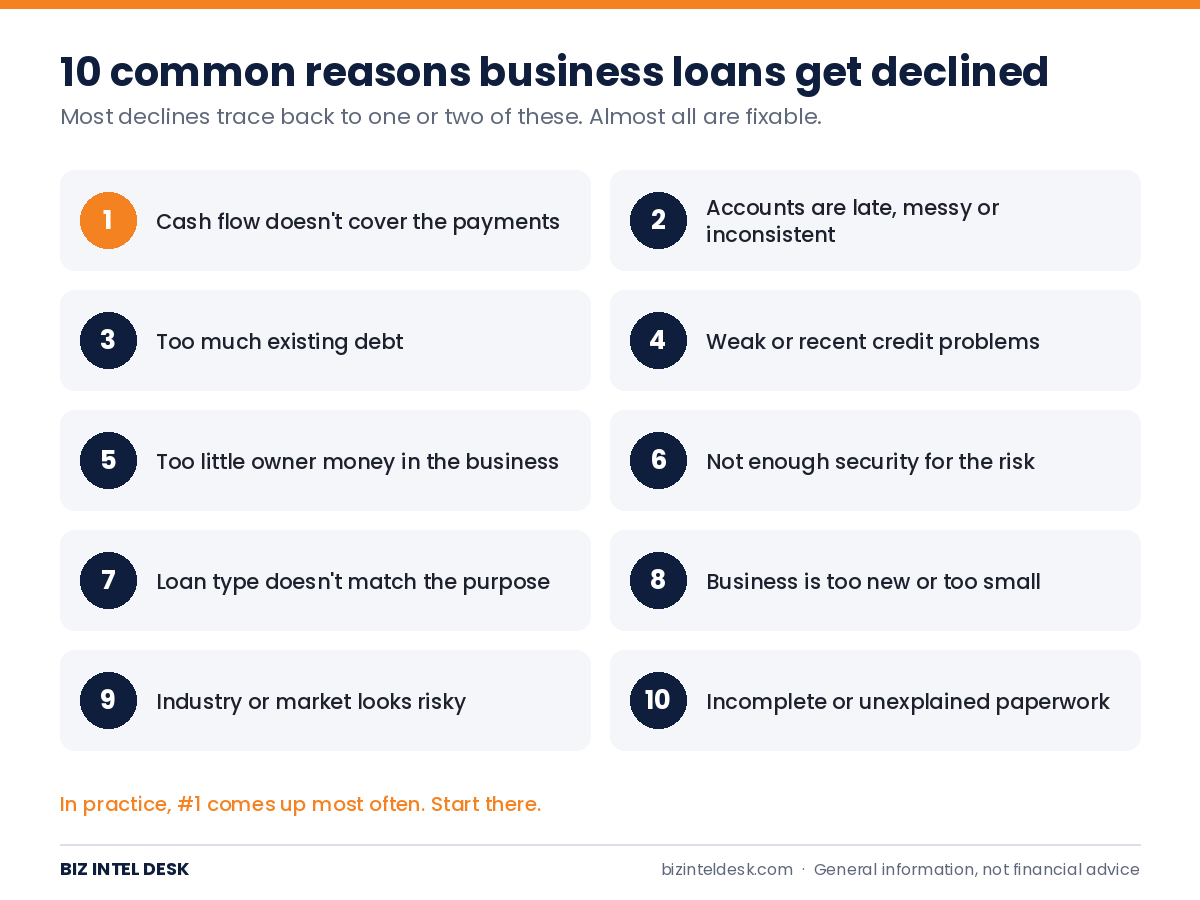
1. The cash flow doesn’t cover the payments
This is the big one. If the business can’t comfortably pay the new loan out of its normal cash flow, most banks stop there. They usually measure it with the debt service coverage ratio (DSCR), and they always include the new loan in the sum.
What to do: work out your DSCR yourself first. If it’s thin, ask for less, ask for a longer term, or pay down some existing debt before you apply.
2. The accounts are late, messy or don’t add up
If your accounts are a year old, or the numbers in your tax return don’t match your management accounts, the underwriter can’t trust any of it. And when they can’t trust the numbers, the answer is almost always no.
What to do: get up-to-date accounts prepared by an accountant, and be ready to explain any big differences between periods.
3. There’s already too much debt
Even a profitable business can be “full”. If your existing loans, leases and credit lines already take most of your spare cash, there’s no room left for another payment.
What to do: list every debt and what it costs you each month. Sometimes combining two expensive facilities into one cheaper loan does more than asking for new money.
4. Credit history problems
Recent late payments, defaults or court judgments, on the business or on the owners’ personal credit, make banks nervous. It’s their only real window into how you behave when money gets tight.
What to do: check your reports before the bank does. If something bad is on there, explain it upfront, with evidence that it’s been sorted. A surprise is always worse than a disclosed problem.
5. Not enough of your own money in the business
If you’re asking the bank to take all the risk, expect resistance. Banks want to see owners with real money at stake.
What to do: show what you’ve already put in, and consider adding a contribution to the project you’re asking them to fund.
6. Not enough security for the risk
Collateral isn’t the main reason banks lend, but it matters when the risk is higher. And banks value assets well below what owners expect. We cover how in collateral and loan-to-value explained.
What to do: know what your assets are really worth to a lender, not just on paper. Be prepared for a request for a personal guarantee if security is thin.
7. The loan doesn’t fit the purpose
Using a line of credit to buy a building, or a five-year loan to cover a two-month cash gap. When the product doesn’t match the need, banks will say no or restructure it, even if the numbers are fine.
What to do: match short-term needs with short-term money, and long-term assets with long-term loans. If you’re not sure, ask your banker which product fits.
8. The business is too new or too small
Many banks want to see at least two years of trading before they lend on the business’s own strength. Before that, there’s just not enough history to judge.
What to do: look at smaller facilities first, government-backed schemes where your country has them, or lenders that specialise in younger businesses. Build a track record, then come back.
9. The industry or market looks risky
Some sectors are simply harder to lend to because they’re cyclical, heavily regulated or going through a rough patch. That’s not personal. It’s the bank’s overall appetite.
What to do: show what makes your business different from the sector average. Long-term contracts, loyal customers, low costs. If one bank won’t touch your industry, another might.
10. Missing or unexplained paperwork
An incomplete file sits in a queue. Unexplained large cash deposits, transfers to family members or missing tax filings raise questions that can stall or sink an application.
What to do: hand over a complete pack on day one. Our guide to how banks evaluate loan applications has a checklist. Add a short note explaining anything unusual before anyone has to ask.
Declined? What to do next
- Ask why. Politely ask your relationship manager what the main concern was. Most will give you a straight answer off the record.
- Fix the actual reason. Not the one you assume. A second application with the same problem gets the same answer.
- Wait before reapplying. Firing off applications to several banks at once can leave a trail of credit searches. Fix first, then apply.
- Consider a smaller or different facility. Sometimes a “no” to one product is a “yes” to another.
Watch: why lenders say no
From the credit desk
What we look for when this comes up in a real credit file:
- The most common reason we see is weak repayment capacity: cash flow that does not cover existing debt plus the new request with enough margin.
- Inconsistent documents come second. Sales figures that differ between the financial statements, tax returns and bank statements undermine the whole file.
- A decline is rarely final. Ask which numbers fell short, fix them, and reapply with a short note on what has changed.
Questions people often ask
What is the most common reason business loans are declined?
Weak or inconsistent cash flow. If the business can’t clearly afford the repayments, other strengths rarely make up for it.
Does a declined loan hurt my credit?
The decline itself usually isn’t recorded, but the credit searches from each application can be, depending on the country and lender. Lots of applications in a short time can look bad.
How soon can I reapply after a decline?
There’s no fixed rule. What matters is that the reason for the decline has changed. For most businesses, that means waiting until you have new accounts or a clear improvement to show, often a few months.
Will the bank tell me why I was declined?
Rules differ by country. Some lenders must give a reason; others don’t. In practice, a relationship manager will often explain the main concern if you ask.
Keep reading
- How banks actually evaluate a business loan application
- Debt service coverage ratio (DSCR), explained
- The working capital cycle, explained
- Free business loan calculators
Check before you apply: Run your numbers through our free DSCR calculator and LTV calculator to spot weak areas before a lender does.
Sources and further reading
- State Bank of Pakistan: Laws and Regulations (Prudential Regulations)
- U.S. Small Business Administration: Loans
This is general information about how business lending usually works, not financial or legal advice. Every bank, country and loan is a bit different, so check the details with your own lender or adviser.
Related: the SME Loan Package Starter Kit calculates DSCR, ratios and repayment schedules in one Excel file.
Free Business Loan Application Checklist
The 10 documents lenders usually ask for, plus the key ratios to check before you apply, on a printable 2-page checklist. Enter your email and download it free.
We only use your email to send the download and occasional helpful updates. Ask us any time to remove it. See our Privacy Policy.