

Most owners asking for a line of credit or a loan assume the bank mainly cares about what the business earns. That’s only half of it. With younger companies especially, the bank is reading two credit histories side by side: yours and the business’s. They don’t always tell the same story.
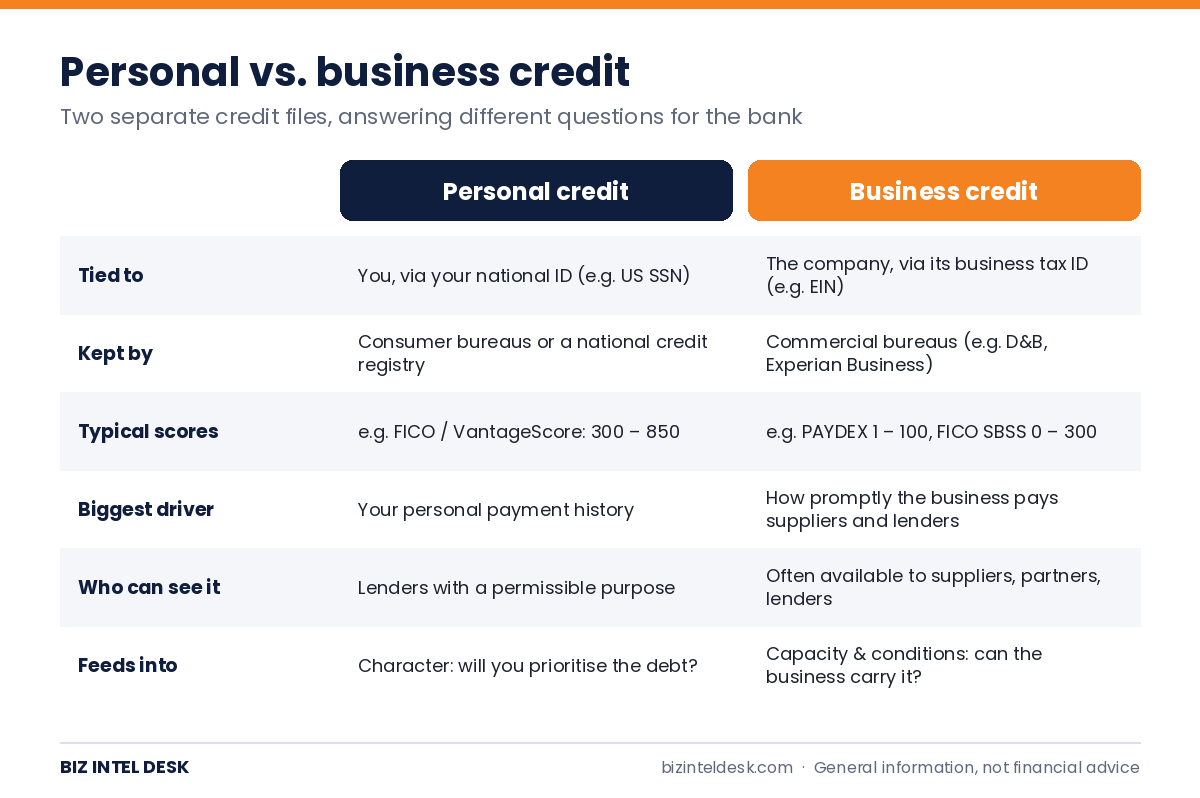
Personal credit: the one you already know
This is your record as an individual, linked to your national ID and held by consumer credit bureaus or, in many countries, a central bank credit registry.
In the US, that means your Social Security number, three bureaus (Experian, Equifax and TransUnion) and a FICO or VantageScore between 300 and 850. Elsewhere the names change. India has the CIBIL score. In Pakistan, banks pull your eCIB report from the State Bank. But the idea is the same everywhere: how reliably have you paid back what you borrowed?
Under FICO, the most common US model, payment history is the biggest factor at about 35%. After that comes how much of your available credit you’re using, how long you’ve had credit, the mix of accounts and how many new applications you’ve made lately. Other systems weigh things differently, but paying on time matters most almost everywhere.
If your business is less than a couple of years old, this is often what the bank leans on hardest. Not because they don’t care about the company. There just isn’t much company history to look at yet, so your personal record fills the gap.
Business credit: a different animal
Business credit belongs to the company, not to you. It’s linked to the company’s registration or tax number (an EIN in the US) and held by commercial bureaus most owners have never heard of until they need a loan.
In the US, the big names are Dun & Bradstreet, Experian Business and Equifax Small Business. D&B’s PAYDEX score runs from 1 to 100 and is based almost entirely on how quickly you pay suppliers. FICO’s SBSS score, which many US banks use for small business loans, runs from 0 to 300 and blends the owner’s personal credit, business credit data and the company’s financials.
Here’s the part that surprises people: business credit isn’t private the way personal credit is. In the US, for example, suppliers, lenders and other companies can generally buy your business credit report without asking you. Liens and court judgments against the company can show up there too.
Where the two meet
However closely the bank looks at the business, most decisions still come back to the five Cs of credit.
Your personal credit mostly answers character: when money is tight, will you keep paying? The business’s credit and accounts mostly answer capacity: can the company’s cash flow carry the loan? That’s usually measured with DSCR. They also feed into conditions.
One doesn’t replace the other. They’re answering different questions.
Why you should keep them apart
A lot of declined applications trace back to owners mixing personal and business money for too long. The obvious risk is that your house and savings end up exposed to business debt. But there are two more practical reasons to separate them early.
First, once the business stands on its own, it can usually get much bigger limits than any personal card, sized to its cash flow rather than your salary. Second, a business with its own clean credit record is easier to finance, value and sell. If you ever bring in a partner or a buyer, that track record is part of what they’re paying for. If it’s all tangled up with your personal file, there’s far less for them to buy.
How to start building business credit
The details depend on where you are, but the steps look much the same almost everywhere:
- Register the business properly and get its own tax or registration number.
- Open a separate business bank account and run everything through it.
- Get on the commercial bureaus’ radar where they exist. In the US, that starts with a free D-U-N-S number from Dun & Bradstreet.
- Use suppliers and lenders that report your payments, and open small trade accounts in the company’s name.
- Pay on time, every time. Early is even better. Payment behaviour drives most business scores.
- Keep your filings up to date and check your reports at least once a year. Fix mistakes before a lender finds them.
The bottom line
Your personal credit gets the business through the door the first time. Business credit is what lets the company borrow on its own later, without your personal record deciding every application. The sooner you start building a separate file, the sooner you get there.
Watch: business credit vs. personal credit
From the credit desk
What we look for when this comes up in a real credit file:
- For small businesses and sole proprietors, the owner’s personal credit report is usually checked alongside the business. Late personal payments affect the business application.
- In Pakistan, banks check the credit bureau report for the borrower, its directors and guarantors. Overdue amounts on any of them can hold up approval.
- Keeping business and personal accounts separate makes your business cash flow easier to verify and strengthens the application.
Questions people often ask
Does my personal credit affect a business loan?
Usually, yes, especially for small or new businesses. Banks often check the owners’ credit and may ask for a personal guarantee, which ties you to the loan.
Can the business have good credit if mine is bad?
Over time, yes. But for small businesses most banks will still look at the owners. A weak personal record can hold you back until the company has a long, solid history of its own.
Will business debt show up on my personal report?
It depends on the product and the country. Loans you personally guarantee, and some business cards, can appear on your personal file, especially if payments are missed. Ask the lender how they report it.
How long does it take to build business credit?
Bureaus usually need a few reporting accounts and a few months of payments before a score appears. Getting strong enough to borrow without leaning on your personal credit typically takes a couple of years.
Keep reading
- Personal guarantees: what you’re really signing
- Why banks decline business loans: 10 common reasons
- How banks actually evaluate a business loan application
- Collateral and loan-to-value (LTV), explained
- Free business loan calculators
- The working capital cycle, explained
Try it yourself: Lenders weigh your business’s repayment capacity alongside your personal record. Test the business side with our free DSCR calculator and borrowing capacity calculator.
Sources and further reading
- Consumer Financial Protection Bureau: Credit reports and scores
- State Bank of Pakistan: Laws and Regulations (Prudential Regulations)
This is general information about how business lending usually works, not financial or legal advice. Every bank, country and loan is a bit different, so check the details with your own lender or adviser.
Related: the SME Loan Package Starter Kit calculates DSCR, ratios and repayment schedules in one Excel file.
Free Business Loan Application Checklist
The 10 documents lenders usually ask for, plus the key ratios to check before you apply, on a printable 2-page checklist. Enter your email and download it free.
We only use your email to send the download and occasional helpful updates. Ask us any time to remove it. See our Privacy Policy.