

At some point in almost every small business loan, the bank slides a document across the table and says, “We’ll also need a personal guarantee from the directors.” A lot of owners sign it in the same breath as everything else. It deserves more attention than that.
Here’s what a personal guarantee actually is, what you’re agreeing to, and what’s worth negotiating before you sign.
What a personal guarantee is
A personal guarantee is a promise that if the company can’t repay the loan, you will, from your own money and assets.
Limited companies exist partly to separate the owners from the business’s debts. A guarantee deliberately removes that protection for this one lender. If the business fails, the bank can come after you personally for what’s owed, up to whatever the guarantee covers.
Why banks ask for one
From the bank’s side, it’s about two things.
- Commitment. An owner with their own money on the line is far less likely to walk away when things get hard. It’s the same logic as the “character” question in the five Cs of credit.
- A second way out. If the business’s cash flow and collateral fall short, the guarantee gives the bank another source of repayment.
For small and young companies, a guarantee is often standard. Some government-backed schemes require one too. In the US, for example, SBA-backed loans generally need guarantees from anyone who owns 20% or more of the business.
Unlimited vs. limited guarantees
Not all guarantees are the same, and this is where it pays to read carefully.
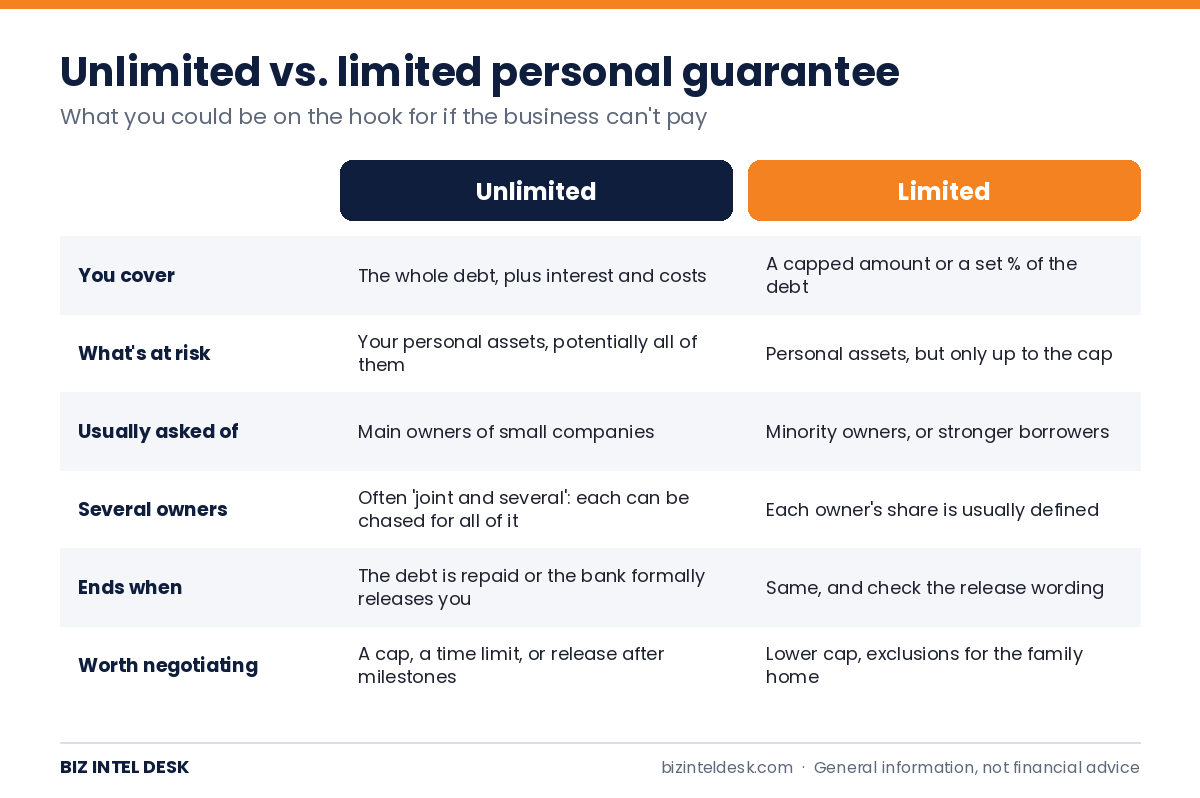
- Unlimited: you guarantee the full debt, plus interest, fees and the bank’s recovery costs. In theory, everything you own is exposed.
- Limited: your liability is capped at a fixed amount or a percentage of the loan.
Watch for the words “all monies”. An all-monies guarantee can cover every debt the company owes that bank, not just this loan. That includes facilities taken out years later.
And if there are several guarantors, check whether it’s “joint and several”. If it is, the bank can chase any one of you for the whole amount, not just your share. Sorting it out between the owners is then your problem, not the bank’s.
Things owners often don’t realise
- It usually survives the company. If the business goes into liquidation, the guarantee doesn’t disappear. That’s exactly when it’s used.
- Selling your shares doesn’t end it. If you leave the business, you stay liable until the bank formally releases you in writing. Always ask for that release as part of any exit.
- Your home may be involved. Some guarantees are backed by a charge over personal property. Even when they’re not, a court judgment can eventually reach personal assets.
- Your spouse or partner may need to be involved. Depending on the country and how property is owned, the bank may ask a spouse to sign or consent.
What you can negotiate
Banks don’t always move on guarantees, but they move more often than people think, especially for stronger businesses. Things worth asking for:
- A cap. Limit the guarantee to a fixed amount or a share of the loan, rather than the full debt.
- Just this facility. Ask to replace “all monies” wording with a guarantee tied to this specific loan.
- Several, not joint. With multiple owners, ask for each person’s liability to be limited to their share.
- A step-down or release. For example, the guarantee reduces as the loan is repaid, or falls away once the business hits agreed targets for a set period.
- Exclusions. Ask whether your main home can be excluded from any security.
Your bargaining power comes from the same place as everything else in lending: strong cash flow cover, good security and a clean track record.
Before you sign
- Read the whole document, not just the summary. Look for the amount, the facilities covered, and how you get released.
- Get independent legal advice. Many banks will actually require it, and it’s worth every penny.
- Keep a copy, and keep a list of every guarantee you’ve given. Owners often forget old ones.
- Talk to your co-owners and your family. It affects them too.
Watch: personal guarantees explained
From the credit desk
What we look for when this comes up in a real credit file:
- Banks ask for personal guarantees from sponsors of private companies because the owners control the cash. It is standard practice, not a sign of distrust.
- A guarantee is usually unlimited unless it states a cap. Read whether it covers only this facility or all present and future liabilities to the bank.
- Ask what would allow the guarantee to be released, for example a set number of years of clean repayment or a lower debt level.
Questions people often ask
Can I get a business loan without a personal guarantee?
Sometimes, usually once the business is well established with strong cash flow and security of its own. For small or new companies, most banks will ask for one.
What happens if the business can’t pay and I’ve signed a guarantee?
The bank will usually demand payment from the guarantors after the business defaults. If you can’t pay, it can take legal action to recover the money from your personal assets, up to the guarantee’s limit.
Does a personal guarantee show on my credit report?
Usually not while things are fine. It can appear if the bank calls on the guarantee and you don’t pay, which can then harm your personal credit.
How do I get released from a personal guarantee?
Only the bank can release you, and it should be in writing. Common routes are repaying the loan, refinancing without a guarantee, or agreeing a release when you sell your shares.
Keep reading
- Personal credit vs. business credit
- Collateral and loan-to-value (LTV), explained
- Why banks decline business loans: 10 common reasons
- What your banker wishes you knew before you ask for a line of credit
- Free business loan calculators
- The working capital cycle, explained
Know your standing: A strong business case reduces how much a bank leans on your guarantee. Check what the business can carry on its own cash flow with our borrowing capacity calculator and DSCR calculator.
Sources and further reading
- State Bank of Pakistan: Laws and Regulations (Prudential Regulations)
- Consumer Financial Protection Bureau: Credit reports and scores
This is general information about how business lending usually works, not financial or legal advice. Every bank, country and loan is a bit different, so check the details with your own lender or adviser.
Related: the SME Loan Package Starter Kit calculates DSCR, ratios and repayment schedules in one Excel file.
Free Business Loan Application Checklist
The 10 documents lenders usually ask for, plus the key ratios to check before you apply, on a printable 2-page checklist. Enter your email and download it free.
We only use your email to send the download and occasional helpful updates. Ask us any time to remove it. See our Privacy Policy.