

You can have a great rate quote, a friendly relationship manager and a polished business plan. None of it counts until your file gets through underwriting. So let’s talk about what happens on the other side of the desk.
Most owners meet their bank through a relationship manager. Usually a decent person who likes your business and wants the deal to happen. But in most banks, the RM doesn’t approve the loan alone. The file goes to credit, and credit boils your application down to a handful of questions. They ask them in roughly the same order, bank after bank.
Bankers call these the five Cs of credit. I know, it sounds like something from a training slide. It is. But it’s also a pretty accurate map of what gets checked and why.
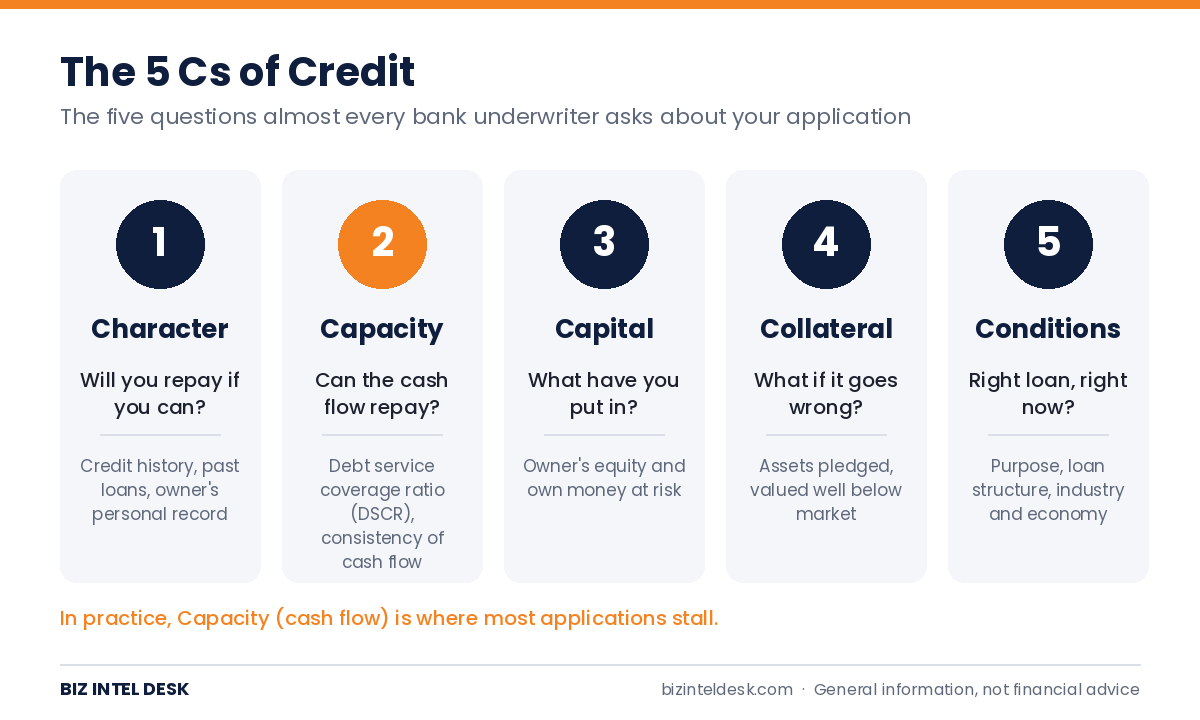
1. Character: will you pay if you can?
Before anyone opens your financials, they look at your history. Credit reports for the business and, for smaller companies, the owner’s personal credit. Past defaults. Late payments. How you handled your last loan.
It isn’t a judgement on you as a person. The bank is trying to answer one question it can’t answer any other way: when money gets tight, will this borrower keep paying us, or will we be at the back of the queue?
2. Capacity: can the business actually repay?
This is the big one. Credit wants to see that your cash flow covers the loan payments with room to spare, and they usually measure it with the debt service coverage ratio (DSCR).
Growth is nice. Consistency is nicer. A business with flat, predictable cash flow often gets approved faster than one that doubled revenue last year but swings wildly month to month.
From what I’ve seen, more files get declined or stuck here than anywhere else. The good news is that capacity problems are often fixable. Cleaner books, better timing, or a smaller ask can change the answer.
3. Capital: how much of your own money is in?
Banks like to see the owner’s money at risk alongside theirs. Partly because owners with skin in the game don’t walk away easily. Partly because it shows you believe in the plan.
Asking the bank to fund 100% of something, with nothing from you, is a very different conversation from asking for a loan next to a real contribution of your own.
4. Collateral: what if things go wrong?
Owners tend to focus on collateral more than banks do. For the bank, it’s the backup plan, not the reason to lend.
Property, equipment, stock and receivables are all common security. Just know that the bank will value them well below what you think they’re worth. A loan that isn’t fully covered isn’t automatically declined, but expect a higher rate or a request for a personal guarantee.
5. Conditions: is this the right loan right now?
Last, credit looks outward. How is your industry doing? What’s the money for? Does the product fit the purpose?
That last point trips people up. If you want a line of credit to buy a building, expect pushback even if everything else looks great. Short-term money for long-term assets is a mismatch banks are trained to spot.
What to have ready before your first meeting
Every bank has its own list, but this is the pack I’d want to see on most small business loans. Walk in with it and you’ll save yourself weeks of back and forth.
- Financial statements for the last two or three years, plus this year’s management accounts.
- Tax returns for the business, and often for the owners too.
- Six to twelve months of bank statements.
- A simple list of every loan, lease and credit line you already have, with balances and monthly payments.
- Aged receivables and payables, especially if you’re asking for working capital.
- Company registration documents and ID for the main owners or guarantors.
- A short note on what the money is for and how you’ll pay it back. Half a page is fine.
The short version
- Tidy, consistent accounts beat an exciting growth story.
- Work out your DSCR before you apply. Don’t let the bank be the first to tell you.
- Be ready to show what you’ve put in, not just what you want.
- Pick the loan type that matches what you’ll use the money for.
None of this is secret. It just rarely gets explained to people before they apply, which is why a decline can feel random. It usually isn’t. Nine times out of ten, one of these five boxes simply wasn’t ticked.
Watch: the 5 Cs in practice
From the credit desk
What we look for when this comes up in a real credit file:
- A credit proposal usually covers the borrower’s background, purpose of financing, financial analysis, security, risks and mitigants, and the recommendation. Giving the bank a clear story for each section speeds things up.
- Purpose matters. A request that matches the financing type, such as working capital for stock or a term loan for machinery, is easier to approve.
- Credit risk reviewers ask questions back. Quick, documented answers to their queries are the fastest way to get a decision.
Questions people often ask
What are the 5 Cs of credit?
Character, capacity, capital, collateral and conditions. In plain terms: your track record, your cash flow, your own money in the business, your security, and whether the loan makes sense for its purpose and the economy around you.
Which one matters most?
Capacity, almost always. Good collateral rarely saves an application where the cash flow doesn’t work.
How long does a decision take?
Anything from a few days for a small, simple facility to several weeks for bigger or secured loans. The biggest thing you control is handing over a complete file on day one.
Can I borrow without collateral?
Sometimes. Unsecured business loans exist, but they tend to be smaller, cost more and come with a personal guarantee.
Keep reading
- Why banks decline business loans: 10 common reasons
- Personal guarantees: what you’re really signing
- Collateral and loan-to-value (LTV), explained
- The working capital cycle, explained
- Free business loan calculators
Try it yourself: Run the same first checks a credit analyst would with our free DSCR calculator, LTV calculator and working capital calculator.
Sources and further reading
- State Bank of Pakistan: Laws and Regulations (Prudential Regulations)
- U.S. Small Business Administration: Plan your business
This is general information about how business lending usually works, not financial or legal advice. Every bank, country and loan is a bit different, so check the details with your own lender or adviser.
Related: the SME Loan Package Starter Kit calculates DSCR, ratios and repayment schedules in one Excel file.
Free Business Loan Application Checklist
The 10 documents lenders usually ask for, plus the key ratios to check before you apply, on a printable 2-page checklist. Enter your email and download it free.
We only use your email to send the download and occasional helpful updates. Ask us any time to remove it. See our Privacy Policy.