

Plenty of profitable businesses run out of cash. It sounds like a contradiction, but it happens all the time, and the working capital cycle is usually why.
If you understand this one idea, you’ll understand why your bank asks so many questions about stock and debtors, and why a line of credit exists in the first place.
What the working capital cycle is
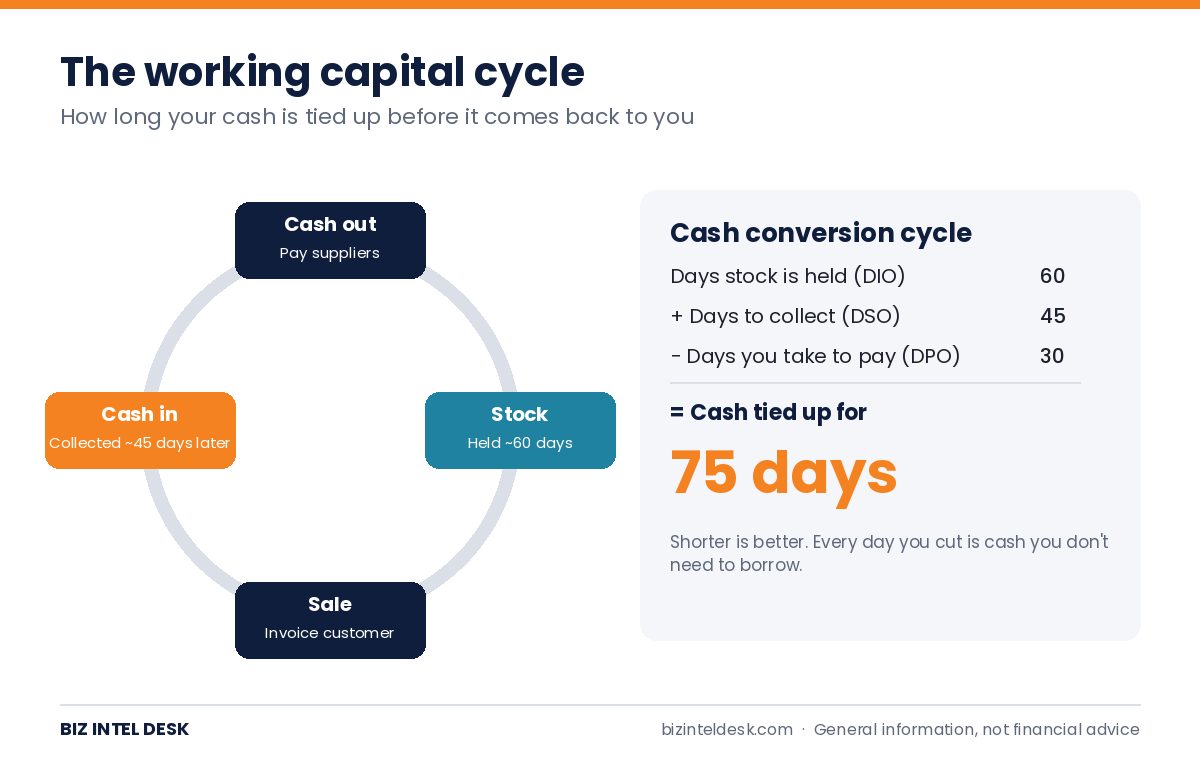
It’s the time between paying out cash for your business and getting it back from customers. Picture a trading business:
- You buy stock and pay the supplier.
- The stock sits in your warehouse until it sells.
- You sell it and send an invoice.
- The customer pays you, weeks later.
Between step 1 and step 4, your cash is tied up. The longer that gap, the more money you need just to keep the business running, before a single penny of profit reaches your bank account.
How to measure it: the cash conversion cycle
Bankers and accountants measure the gap in days, using three numbers:
| Measure | What it tells you | Rough formula |
|---|---|---|
| Days inventory outstanding (DIO) | How long stock sits before it sells | Stock ÷ cost of sales × 365 |
| Days sales outstanding (DSO) | How long customers take to pay | Trade debtors ÷ sales × 365 |
| Days payables outstanding (DPO) | How long you take to pay suppliers | Trade creditors ÷ cost of sales × 365 |
Then: Cash conversion cycle = DIO + DSO − DPO
A worked example
Say your stock sits for 60 days on average, customers take 45 days to pay, and you pay suppliers after 30 days.
60 + 45 − 30 = 75 days. So every time you go round the cycle, your cash is locked up for about two and a half months.
Now put a number on it. If your cost of sales is 900,000 a year, that’s roughly 2,470 a day. Seventy-five days of that is about 185,000 of cash you need to fund the cycle. As you grow, that number grows with you. That’s why fast-growing businesses so often feel cash-poor.
The good news runs the other way too. Cut the cycle by just 10 days and you free up roughly 25,000 of cash, without borrowing a thing.
Why your bank cares
- It sizes your facility. A sensible working capital line is roughly the cash your cycle ties up at its peak. Ask for much more and the bank wonders why. Ask for much less and you’ll be back in three months.
- It shows discipline. Debtor days creeping up or stock building up are early warning signs. Banks watch them closely, especially at annual renewal.
- It feeds into repayment ability. Cash stuck in stock and debtors isn’t available for loan repayments, which drags down your DSCR.
- It drives borrowing bases. On asset-backed lines, your limit is tied to your receivables and stock. The same numbers, seen from the other side.
Ways to shorten your cycle
- Get paid faster. Invoice the same day you deliver, set clear payment terms, chase late payers promptly and consider small early-payment discounts.
- Carry less stock. Find slow-moving items and clear them. Order smaller amounts more often where you can.
- Agree better terms with suppliers. Moving from 30 to 45 days’ credit, without damaging the relationship, directly shortens your cycle.
- Take deposits. For custom or large orders, an upfront deposit funds part of the cycle for you.
- Watch it monthly. Track debtor days, stock days and creditor days every month, not once a year.
Bring these numbers to your next bank meeting. It’s one of the clearest signs that you understand your business the way a lender does.
Watch: the cash conversion cycle, explained
From the credit desk
What we look for when this comes up in a real credit file:
- We calculate the gap between debtor days plus inventory days and creditor days. That gap, multiplied by daily costs, gives the working capital the business needs financed.
- Banks finance the gap, not the whole balance sheet. A request for a limit larger than the calculated gap needs a clear reason, such as seasonal stock building.
- Drawing power for running finance is usually based on stock and receivables minus margins, so the quality of those assets limits how much you can draw.
Questions people often ask
What is a good cash conversion cycle?
It depends heavily on your industry. Supermarkets can have very short or even negative cycles, while manufacturers and distributors often run 60 to 120 days or more. What matters most is the trend over time and how you compare with similar businesses.
Can the working capital cycle be negative?
Yes. If customers pay you before you pay suppliers, as with many retailers and subscription businesses, the cycle is negative and customers are effectively funding your business.
Is working capital the same as the working capital cycle?
Not quite. Working capital is a balance sheet figure, usually current assets minus current liabilities. The cycle is about time: how many days cash is tied up. They’re closely linked, though.
Which loan is best for funding working capital?
Usually a revolving facility such as an overdraft or line of credit, or invoice finance, because the need goes up and down. Using a long-term loan to plug a short-term cash gap is a classic mismatch banks try to avoid.
Keep reading
- What your banker wishes you knew before you ask for a line of credit
- Debt service coverage ratio (DSCR), explained
- Collateral and loan-to-value (LTV), explained
- How banks actually evaluate a business loan application
- Why banks decline business loans: 10 common reasons
- Personal credit vs. business credit: how banks evaluate both
Try it yourself: Enter your current assets and liabilities in our free working capital calculator, then check your full cycle with the cash conversion cycle calculator.
Sources and further reading
- State Bank of Pakistan: Laws and Regulations (Prudential Regulations)
- IFRS Foundation: IAS 7 Statement of Cash Flows
This is general information about how business lending usually works, not financial or legal advice. Every bank, country and loan is a bit different, so check the details with your own lender or adviser.
Related: the SME Loan Package Starter Kit calculates DSCR, ratios and repayment schedules in one Excel file.
Free Business Loan Application Checklist
The 10 documents lenders usually ask for, plus the key ratios to check before you apply, on a printable 2-page checklist. Enter your email and download it free.
We only use your email to send the download and occasional helpful updates. Ask us any time to remove it. See our Privacy Policy.