

At some point, your bank will send you a term sheet. It’s usually a few pages long, full of short headings and abbreviations, and it’s tempting to jump straight to the interest rate and sign. Don’t. The term sheet is where most of the deal is decided, and it’s far easier to change things now than once the full loan agreement is drafted.
Here’s how to read one, section by section, and what to ask.
What a term sheet is (and isn’t)
A term sheet is a summary of the main terms the bank is offering. It’s the outline the lawyers will later turn into a full loan agreement.
Two things to check straight away:
- Is it indicative or approved? Many term sheets are “indicative” and “subject to credit approval”. That means the bank’s credit team can still change or decline the deal.
- Is it binding? Usually not, except for a few clauses such as fees, confidentiality or exclusivity. Check which parts bind you.
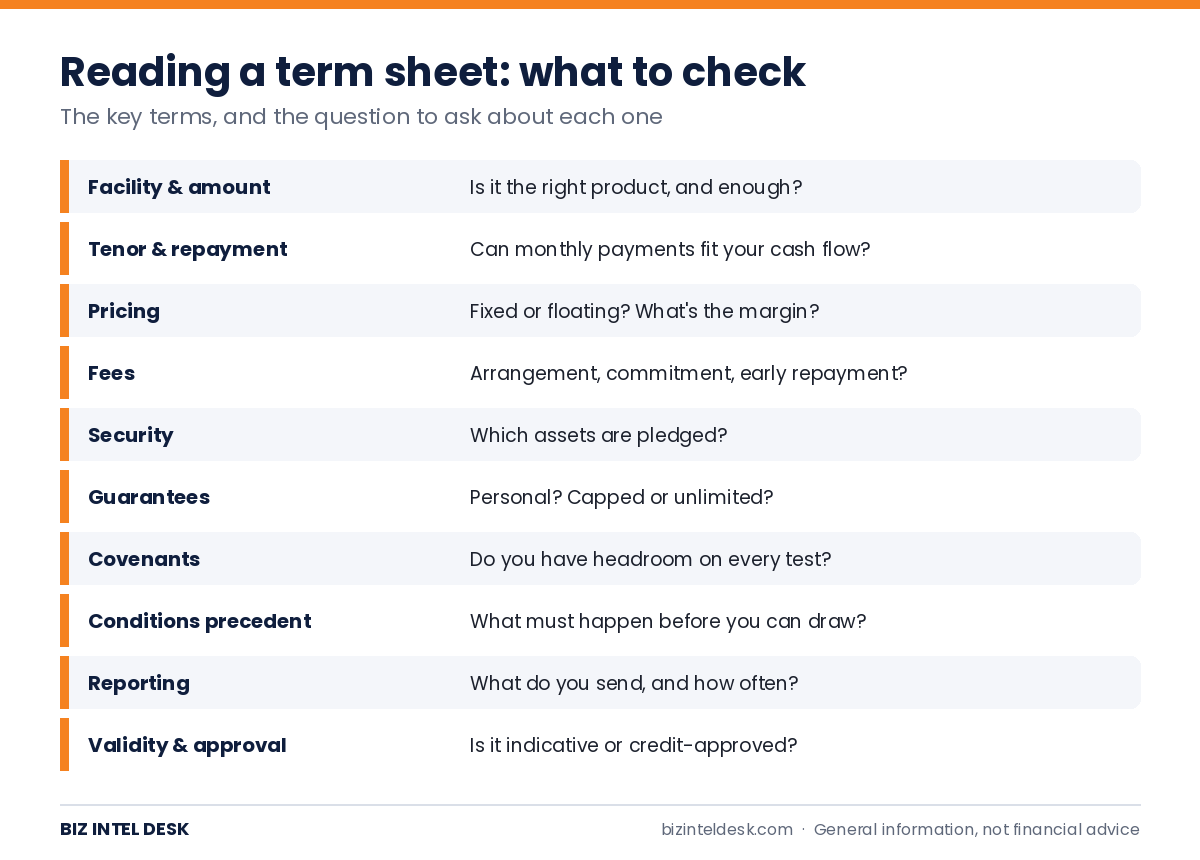
The key terms, one by one
Facility, amount and purpose
Is it the right product? A line of credit for day-to-day needs, a term loan for a specific asset. Is the amount enough, including costs and a buffer? Is the purpose described broadly enough for what you actually plan to do?
Tenor and repayment
How long the loan runs, and how it’s repaid: equal instalments, a grace period, or a large “balloon” payment at the end. Check the monthly or quarterly payment against your cash flow forecast. A longer term lowers payments and helps your DSCR, but costs more interest overall.
Pricing
Is the rate fixed or floating? If floating, what’s the reference rate, and what’s the bank’s margin on top? Ask what the total cost looks like if rates rise by 1% or 2%.
Fees
- Arrangement fee: charged upfront, often a percentage of the loan.
- Commitment fee: on unused parts of a credit line.
- Early repayment fee: if you pay off early or refinance.
- Legal and valuation costs, which are usually yours to pay.
Security
Which assets are pledged? A specific property, all business assets, receivables? Make sure it’s in proportion to the loan. We explain how banks value it in collateral and loan-to-value.
Guarantees
Is a personal guarantee required? Is it capped or unlimited? Does it cover just this loan or “all monies”? This is one of the most important lines on the page.
Covenants
What financial tests will you have to meet, and how often? Check each one against your own numbers and make sure you have real headroom. Our guide to loan covenants and the ratios banks use will help.
Conditions precedent
Everything that must happen before you can draw the money: signed documents, valuations, insurance, board approvals, and so on. Long lists can delay your drawdown, so start on them early.
Reporting
What you must send the bank, and when: annual accounts, management accounts, covenant certificates. Make sure it’s something you can realistically keep up with.
Events of default
The things that let the bank demand repayment: missed payments, covenant breaches, insolvency, cross-default with other lenders. Look for reasonable cure periods and thresholds.
What you can usually negotiate
- The margin and fees, especially if you have offers from other banks.
- Covenant levels and definitions, to build in headroom.
- The scope and cap on any personal guarantee.
- Early repayment fees, particularly if you might refinance.
- The security package, if it’s heavier than the risk justifies.
Pick your battles. Banks rarely move on everything, so focus on the terms that matter most to your business.
Before you sign
- Compare at least two offers if you can. The cheapest rate isn’t always the best deal.
- Run the payments through your cash flow forecast.
- Ask your accountant to check the covenant definitions against your accounts.
- Get legal advice on the guarantee and security documents.
- Ask the banker to explain anything unclear. That’s what they’re there for.
Watch: understanding the term sheet
From the credit desk
What we look for when this comes up in a real credit file:
- Read the conditions precedent first. These are the documents and actions needed before any money is disbursed, and they decide your real timeline.
- Look for cross-default and change-of-control clauses. They can make a problem in one facility, or a change in shareholding, trigger a default across all your borrowing.
- Fees appear in several places: processing, commitment, documentation and early repayment. Add them up to compare the true cost of competing offers.
Questions people often ask
Is a term sheet a loan approval?
Not always. Many are indicative and still need credit approval. Look for wording like “subject to credit approval” and ask your banker where the deal stands.
Is a term sheet legally binding?
Usually not for the main lending terms. Some clauses, such as fees, confidentiality or exclusivity, may be binding. Read the section that says which parts apply.
How long is a term sheet valid?
Often a few weeks to a couple of months. After that, the bank may need to re-price or re-approve it.
Can the terms change after I accept?
They can, especially if credit approval adds conditions or due diligence finds something new. The final loan agreement is what counts, so check it matches the term sheet.
Keep reading
- Loan covenants explained
- Personal guarantees: what you’re really signing
- 6 financial ratios banks use to judge your business
Sources and further reading
- State Bank of Pakistan: Laws and Regulations (Prudential Regulations)
- U.S. Small Business Administration: 7(a) loans
This is general information about how business lending usually works, not financial or legal advice. Every bank, country and loan is a bit different, so check the details with your own lender or adviser.
Want to check this for your own business?
Our SME Loan Package Starter Kit calculates your DSCR, ratios and repayment schedule in one Excel file, with a document checklist and proposal outline.
Free Business Loan Application Checklist
The 10 documents lenders usually ask for, plus the key ratios to check before you apply, on a printable 2-page checklist. Enter your email and download it free.
We only use your email to send the download and occasional helpful updates. Ask us any time to remove it. See our Privacy Policy.