

Getting the loan approved feels like the finish line. It isn’t. For as long as the loan is open, you’ll be living with a set of promises called covenants. Most owners skim them at signing and only really read them when something goes wrong.
Here’s what covenants are, the common ones, and how to stay on the right side of them.
What a covenant is
A covenant is a promise in your loan agreement. You agree to do certain things, not do others, and keep certain numbers above or below agreed levels. They let the bank spot trouble early, long before a missed payment.
Think of them as the bank’s early warning system. If a covenant is breached, the bank gets the right to step in, even if you’ve never missed a payment.
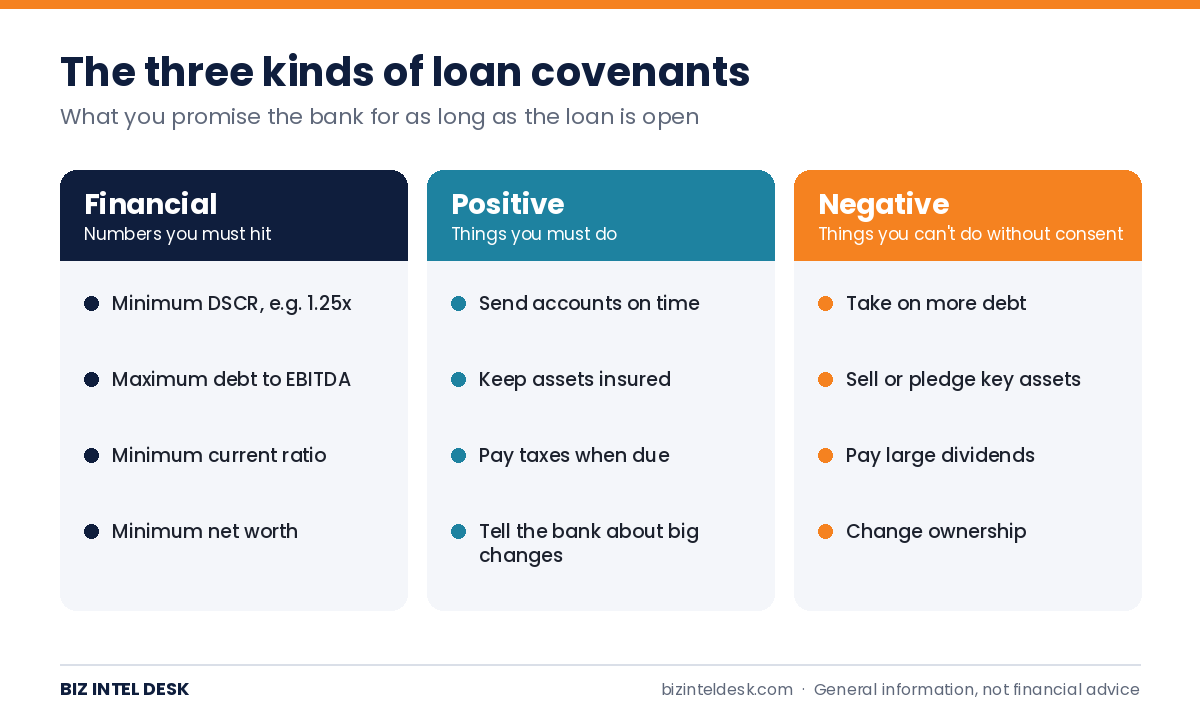
1. Financial covenants: numbers you must hit
These are tests on your accounts, usually checked every quarter or year. Common ones:
- Minimum DSCR. For example, cash flow must be at least 1.25 times your loan payments.
- Maximum leverage. For example, total debt no more than 3 times EBITDA.
- Minimum current ratio. Current assets must stay above current liabilities by a set margin.
- Minimum net worth. Your balance sheet equity can’t fall below an agreed amount.
The exact definitions matter. “EBITDA” or “cash flow” in a loan agreement may be calculated differently from your accountant’s version. Read the definitions section.
2. Positive covenants: things you must do
- Send accounts and compliance certificates on time.
- Keep assets insured, with the bank named where required.
- Pay taxes and keep licences up to date.
- Tell the bank about lawsuits, big losses or major changes in the business.
These sound like admin, but late reporting is one of the most common covenant breaches I’ve seen. It’s also the easiest to avoid.
3. Negative covenants: things you can’t do without asking
- Take on more borrowing from other lenders.
- Sell, lease or pledge key assets.
- Pay dividends or take large withdrawals above an agreed level.
- Change ownership or merge with another company.
None of these are banned forever. You just need the bank’s written consent first. Ask before you act, not after.
Other clauses worth knowing
- Cross-default. A default on another loan can count as a default on this one.
- Material adverse change. Lets the bank act if something seriously damages your business, even if the numbers haven’t breached yet.
- Cure periods. Some agreements give you a short window to fix a breach before it becomes a default.
What happens if you breach one
A breach doesn’t automatically mean the bank will demand its money back. In practice, it usually starts a conversation. Depending on how serious it is, the bank might:
- Give you a waiver, sometimes for a fee.
- Reset the covenant to a more realistic level.
- Increase the interest rate or ask for more security.
- Reduce the limit on a line of credit.
- In serious cases, call the loan in.
The single most useful thing you can do is tell your banker early. A breach you flag yourself, with a plan, is a very different conversation from one the bank discovers on its own.
How to stay compliant
- Negotiate headroom at the start. If you expect a DSCR of 1.5x, don’t accept a covenant at 1.45x. Aim for a comfortable cushion.
- Test yourself monthly. Work out the covenant ratios from your management accounts, not just when the bank asks.
- Put reporting dates in your calendar. Set reminders a couple of weeks ahead.
- Watch cash, not just profit. Cash flow and profit can move very differently, and most covenants depend on cash.
- Ask before big decisions. New borrowing, asset sales or dividends. Get consent first.
Watch: loan covenants explained
From the credit desk
What we look for when this comes up in a real credit file:
- Negotiate covenant levels before you sign, using your own projections. Leave headroom so that one weak quarter does not cause a breach.
- Tell your bank early if you expect to breach a covenant. A waiver requested in advance is far easier to approve than one requested after the breach.
- Reporting covenants, such as submitting audited accounts within a set period, are the ones most often broken, and the easiest to avoid.
Questions people often ask
What is a loan covenant in simple terms?
A promise in your loan agreement to do certain things, avoid others, and keep key financial numbers within agreed limits for as long as the loan is open.
Can I negotiate covenants?
Often, yes, especially the levels and the definitions. Stronger borrowers get more flexibility. It’s much easier to negotiate before signing than after a breach.
How often are covenants tested?
Usually quarterly or annually, based on the accounts you send the bank. Some reporting covenants are monthly.
Do all business loans have covenants?
Most larger loans and credit lines do. Very small or fully secured loans may only have basic reporting and insurance requirements.
Keep reading
- What your banker wishes you knew before you ask for a line of credit
- Debt service coverage ratio (DSCR), explained
- Cash flow vs. profit
Sources and further reading
- State Bank of Pakistan: Laws and Regulations (Prudential Regulations)
- IFRS Foundation: IFRS 9 Financial Instruments
This is general information about how business lending usually works, not financial or legal advice. Every bank, country and loan is a bit different, so check the details with your own lender or adviser.
Related: the SME Loan Package Starter Kit calculates DSCR, ratios and repayment schedules in one Excel file.
Free Business Loan Application Checklist
The 10 documents lenders usually ask for, plus the key ratios to check before you apply, on a printable 2-page checklist. Enter your email and download it free.
We only use your email to send the download and occasional helpful updates. Ask us any time to remove it. See our Privacy Policy.