

When your accounts land on a credit analyst’s desk, one of the first things they do is turn them into ratios. It’s how a bank compares a small trading company with a big manufacturer, or this year with last year, on the same scale.
You don’t need to be an accountant to follow along. Here are the six ratios banks look at most, what each one is really asking, and how to work them out yourself.
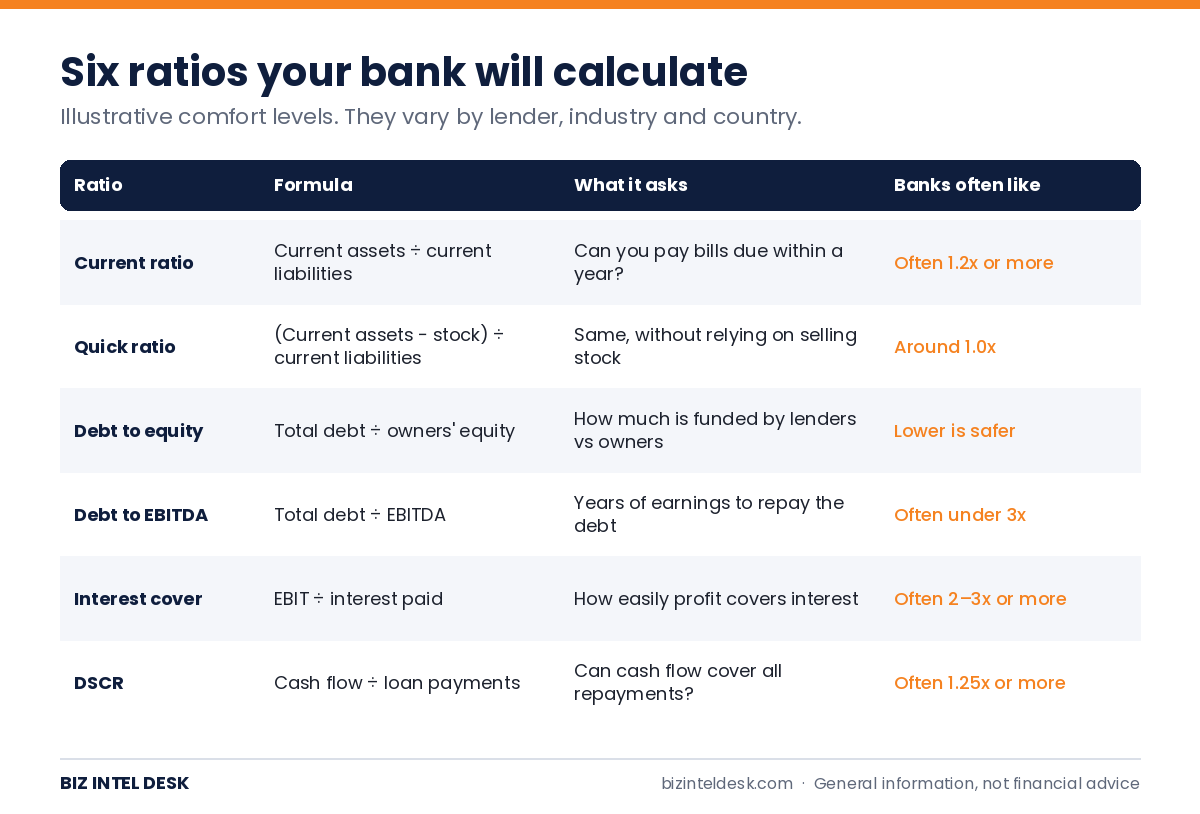
Liquidity: can you pay what’s due soon?
1. Current ratio
Current assets ÷ current liabilities. Current assets are cash, debtors and stock. Current liabilities are what you owe within a year: suppliers, overdraft, tax, the next 12 months of loan payments.
A ratio of 1.5x means you have 1.50 of short-term assets for every 1.00 you owe short term. Below 1.0x, you could struggle to pay bills as they fall due. Many lenders like to see something above about 1.2x, though it depends on the industry.
2. Quick ratio
(Current assets − stock) ÷ current liabilities. The same idea, but it leaves out stock, which can be slow to sell. It’s a stricter test. Around 1.0x is a common comfort level.
Leverage: how much of the business is borrowed?
3. Debt to equity
Total debt ÷ owners’ equity. It shows how much of the business is funded by lenders compared with the owners. A ratio of 2.0x means the bank and other lenders have put in twice as much as the owners. Lower is safer. What’s “too high” varies a lot by sector.
4. Debt to EBITDA
Total debt ÷ EBITDA. Roughly, how many years of earnings it would take to pay off the debt. Many lenders get uncomfortable once small business borrowing goes much above about 3x, though property-heavy businesses are often judged differently. It’s also a common loan covenant.
Coverage: can your earnings carry the debt?
5. Interest cover
EBIT ÷ interest paid. How many times your operating profit covers your interest bill. Below 1.5x or so starts to look tight. Many banks like to see 2 to 3 times or more.
6. Debt service coverage ratio (DSCR)
Cash flow available for debt ÷ total loan payments (interest and principal). This is the big one, because it looks at cash and at the full repayment, not just interest. We’ve covered it in detail in DSCR explained. Many lenders look for 1.25x or more.
A quick worked example
| Figure | Amount |
|---|---|
| Current assets | 500,000 |
| Current liabilities | 350,000 |
| Stock | 200,000 |
| Total debt | 600,000 |
| Owners’ equity | 400,000 |
| EBITDA | 220,000 |
| EBIT | 170,000 |
| Interest | 45,000 |
- Current ratio: 500 ÷ 350 = 1.43x
- Quick ratio: (500 − 200) ÷ 350 = 0.86x
- Debt to equity: 600 ÷ 400 = 1.5x
- Debt to EBITDA: 600 ÷ 220 = 2.7x
- Interest cover: 170 ÷ 45 = 3.8x
A banker would read this as a reasonably healthy business with manageable debt. The one to explain is the quick ratio, which shows the business relies on selling stock to meet its short-term bills.
What banks really do with ratios
- Trends beat snapshots. A current ratio falling from 1.8x to 1.2x over three years worries a bank more than a steady 1.2x.
- They compare you with your industry. A supermarket and an engineering firm will look very different, and banks know that.
- They adjust your numbers. Owner loans, one-off items and related-company balances may be treated differently from your accounts.
- Ratios start questions, not answers. A weak ratio with a good explanation is often fine. An unexplained one isn’t.
How to improve your ratios before applying
- Collect overdue debts and clear slow stock to lift liquidity.
- Leave profits in the business instead of taking them all out, which builds equity.
- Pay down or consolidate expensive short-term debt.
- Make sure your accounts are up to date and correctly classified. Long-term loans wrongly shown as current can make your current ratio look far worse than it is.
- Understand the gap between profit and cash flow, because several of these ratios depend on it.
Watch: debt to equity in credit analysis
Run your own numbers: use our free DSCR calculator to check your figures before you speak to your bank.
From the credit desk
What we look for when this comes up in a real credit file:
- No single ratio decides an application. We read DSCR, leverage, liquidity and turnover ratios together and look for a consistent story.
- Ratios are calculated on adjusted figures: owner drawings, related-party balances and one-off income are normalised before we compare you with peers.
- A deteriorating trend over three years worries credit teams more than one weak year with a clear explanation.
Questions people often ask
What is a good current ratio for a small business?
Many lenders are comfortable around 1.2x to 2.0x, but it depends heavily on your industry and how quickly your stock and debtors turn into cash.
What’s the difference between leverage and gearing?
They mean broadly the same thing: how much of the business is funded by debt. “Gearing” is more common in the UK and Commonwealth countries, “leverage” in the US.
Which ratio matters most to banks?
For loan decisions, usually DSCR, because it shows whether cash flow can cover the full repayment. Liquidity and leverage ratios help build the rest of the picture.
Can I calculate these myself?
Yes. All you need is your balance sheet and profit and loss account. Working them out before you apply helps you spot and explain weak spots before the bank does.
Keep reading
- Debt service coverage ratio (DSCR), explained
- Loan covenants explained
- How banks actually evaluate a business loan application
Sources and further reading
- State Bank of Pakistan: Laws and Regulations (Prudential Regulations)
- IFRS Foundation: IFRS 9 Financial Instruments
This is general information about how business lending usually works, not financial or legal advice. Every bank, country and loan is a bit different, so check the details with your own lender or adviser.
Want to check this for your own business?
Our SME Loan Package Starter Kit calculates your DSCR, ratios and repayment schedule in one Excel file, with a document checklist and proposal outline.
Free Business Loan Application Checklist
The 10 documents lenders usually ask for, plus the key ratios to check before you apply, on a printable 2-page checklist. Enter your email and download it free.
We only use your email to send the download and occasional helpful updates. Ask us any time to remove it. See our Privacy Policy.