

“We made a good profit last year, so why is there no money in the bank?” I’ve heard some version of that from business owners more times than I can count. It’s one of the most common, and most stressful, surprises in running a business.
The answer is that profit and cash are two different things. Banks know this, which is why they care far more about your cash flow than your bottom line.
Profit and cash measure different things
Profit is an accounting result. It’s what’s left from your sales after you take off the costs of earning them. Sales count when you make them, even if the customer hasn’t paid yet. Costs count when you use them up, even if you paid for them last year or will pay next month.
Cash flow is simpler. It’s the actual money that came into your bank account minus the money that went out. Nothing else.
Most of the time the two move roughly together. But in any single year they can be miles apart.
Where the gap comes from
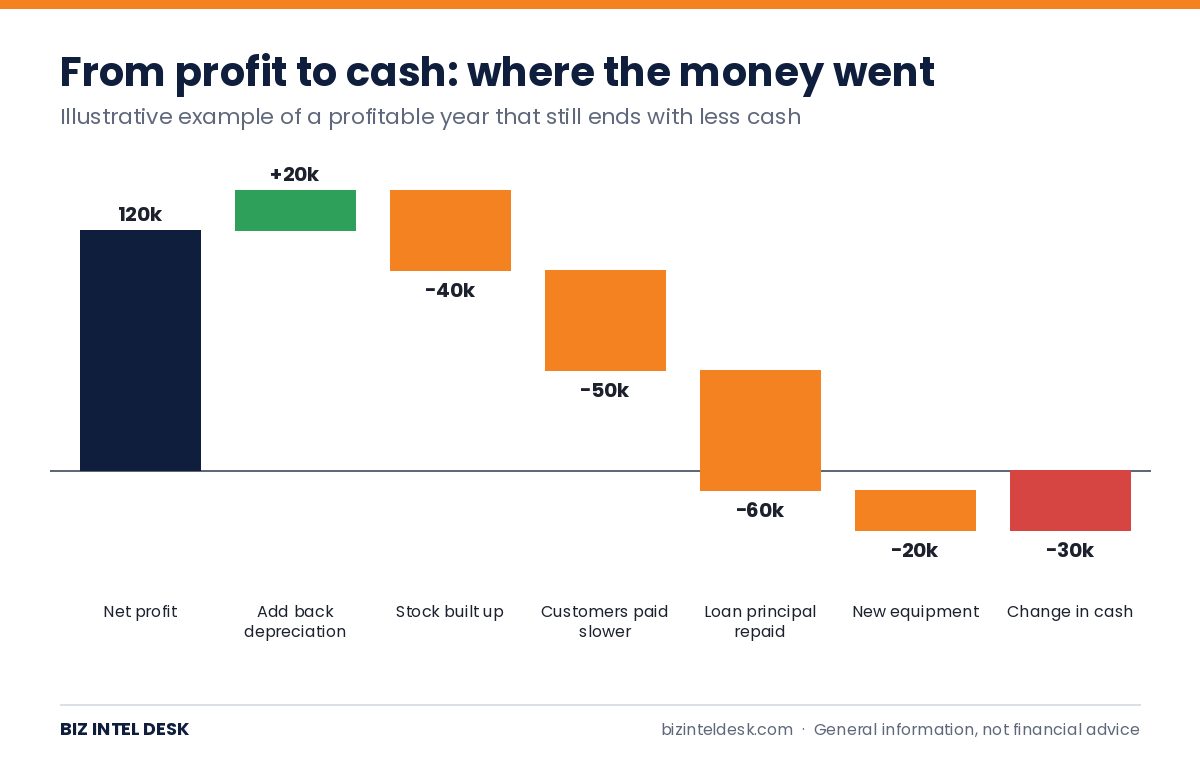
Here’s a simple example. A business makes 120,000 of profit. By year end, its bank balance is actually 30,000 lower than when it started. Where did the money go?
- Depreciation (+20,000). The accounts charged 20,000 for wear and tear on equipment. That reduced profit, but no cash left the business, so we add it back.
- More stock (−40,000). The business bought more stock than it sold. That money is now sitting on shelves.
- Slower customers (−50,000). Sales were booked as profit, but customers haven’t paid yet. The working capital cycle got longer.
- Loan repayments (−60,000). Only the interest on a loan is a cost in the profit and loss account. The capital you repay isn’t, but it still leaves your bank account.
- New equipment (−20,000). Buying an asset is cash out today, but it’s only charged to profit a bit at a time through depreciation.
Add it up, in thousands: 120 + 20 − 40 − 50 − 60 − 20 = −30. A profitable year, and the business is poorer in cash.
Why banks care more about cash
You can’t repay a loan with profit. You repay it with cash. That’s why lenders build their decisions around cash flow measures like the debt service coverage ratio (DSCR), not just net profit.
It’s also why an underwriter will look closely at your debtors and stock. If profit is rising but cash is falling, they’ll want to know why. Sometimes it’s healthy growth. Sometimes it’s customers who won’t pay. The bank needs to know which.
Warning signs to watch
- Profit is up but your overdraft keeps getting deeper.
- Customers are taking longer and longer to pay.
- Stock is growing faster than sales.
- You’re using short-term borrowing to pay for long-term assets.
- You regularly have to delay paying suppliers or tax.
How to keep profit and cash closer together
- Do a simple cash flow forecast. Month by month, money in and money out, for the next 12 months. A spreadsheet is fine.
- Chase what you’re owed. Invoice promptly, and follow up the day a payment is late.
- Keep stock lean. Clear slow-moving items and avoid over-ordering.
- Fund assets properly. Use a term loan or lease for equipment, not your working capital line.
- Plan for loan repayments and tax. They come out of cash, not profit. Set money aside for them.
If you understand the gap between profit and cash, you’ll run your business better, and you’ll have a much easier conversation with your bank.
Watch: cash flow vs. profit
Run your own numbers: use our free working capital calculator to check your figures before you speak to your bank.
From the credit desk
What we look for when this comes up in a real credit file:
- Banks are repaid from cash, not profit. We rebuild your cash flow from the accounts, starting with operating profit and adjusting for changes in debtors, stock and creditors.
- A profitable business with fast-growing debtors can still run out of cash. Explain your collection plan in the application if receivables are rising.
- The cash flow statement in audited accounts is the first place we look. If it is missing or does not reconcile, expect questions.
Worked example: A business reports a PKR 8 million profit, but debtors rise by PKR 6 million and stock by PKR 4 million. Operating cash flow before financing is negative, even though the business is profitable.
Questions people often ask
Can a profitable business go bankrupt?
Yes. A business fails when it can’t pay its bills on time, and that’s about cash, not profit. Fast-growing businesses are especially at risk because growth ties up cash in stock and unpaid invoices.
Is EBITDA the same as cash flow?
No. EBITDA is a useful starting point, but it ignores changes in working capital, tax, capital spending and loan repayments. Real cash flow can be much lower.
Why isn’t loan principal an expense?
Because repaying a loan doesn’t make the business poorer on paper. It reduces cash and reduces debt by the same amount. Only the interest is a cost. But the principal still has to be paid in cash, which is why it matters so much to your bank.
Which statement shows cash flow?
The cash flow statement. It starts from profit and adjusts for non-cash items and changes in working capital, much like the example above.
Keep reading
- Debt service coverage ratio (DSCR), explained
- The working capital cycle, explained
- Why banks decline business loans: 10 common reasons
Sources and further reading
- IFRS Foundation: IAS 7 Statement of Cash Flows
- U.S. Small Business Administration: Plan your business
This is general information about how business lending usually works, not financial or legal advice. Every bank, country and loan is a bit different, so check the details with your own lender or adviser.
Related: the SME Loan Package Starter Kit calculates DSCR, ratios and repayment schedules in one Excel file.
Free Business Loan Application Checklist
The 10 documents lenders usually ask for, plus the key ratios to check before you apply, on a printable 2-page checklist. Enter your email and download it free.
We only use your email to send the download and occasional helpful updates. Ask us any time to remove it. See our Privacy Policy.